Hi everyone, Alex here. Welcome back to the blog.
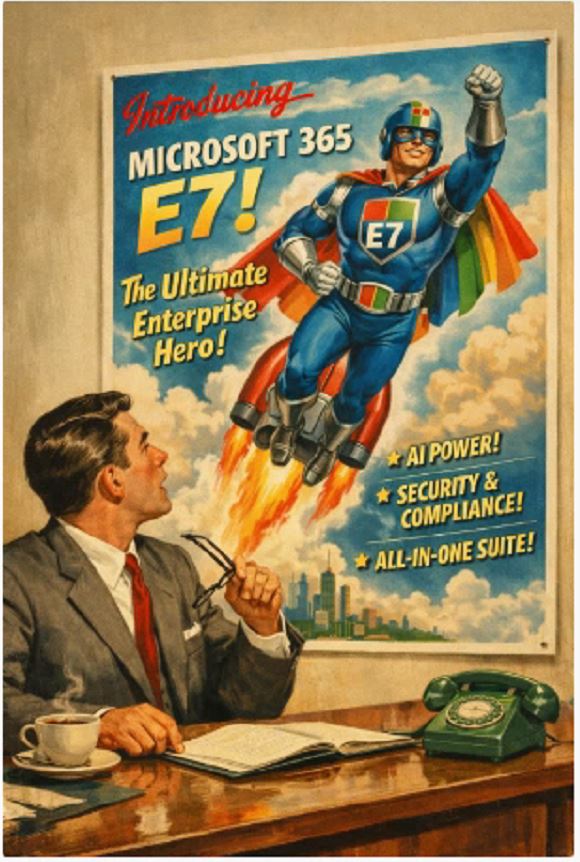
Over the past few weeks I’ve been seeing more and more conversations around a possible Microsoft 365 E7 licence. Nothing official has been released yet, but enough signals have appeared across the ecosystem to start piecing together what Microsoft might be preparing.
So I decided to collect everything that is currently known or reasonably expected and put it into one place. Not rumours for the sake of rumours, but a realistic look at what E7 could become, how it might be structured, and what it could mean for organisations already running E3 or E5.
Because if Microsoft actually launches an E7 tier, it will likely represent a noticeable shift in how enterprise Microsoft environments are packaged and licensed.
Why Microsoft might introduce E7
Most organisations today operate on one of two enterprise plans: Microsoft 365 E3 or Microsoft 365 E5.
E3 provides the productivity platform and the essential security controls needed to run a modern workplace. E5 builds on that foundation with more advanced security, compliance and analytics capabilities. For years E5 has been the highest tier of the Microsoft 365 ecosystem.
But the situation has changed significantly with the arrival of enterprise AI tools.
Microsoft has invested tens of billions of dollars into AI infrastructure and into products such as Copilot, and the company is clearly moving toward a model where AI becomes a core layer of the productivity platform rather than a separate add-on.
That is where a potential E7 plan starts to make sense.
Instead of forcing organisations to combine multiple licences and add-ons, Microsoft could introduce a new top-tier bundle that integrates productivity, security, identity governance and AI capabilities into a single enterprise subscription.
What the E7 stack could include
Although Microsoft has not confirmed the exact structure of the licence, the expected foundation of E7 would likely look familiar.
At a minimum, the plan would probably include the entire Microsoft 365 platform, starting with the core collaboration services:
Teams, OneDrive and SharePoint would remain the backbone of the productivity environment. On top of that foundation, organisations would effectively receive the capabilities currently available in both E3 and E5 licences.
That would include advanced security and compliance functionality delivered through Microsoft Purview, as well as expanded endpoint management through Microsoft Intune. Analytics capabilities through Power BI would likely remain part of the stack, alongside automation features that connect the various services together.
In other words, the productivity and security platform many enterprises already run today would simply become the baseline layer of the E7 environment.
One area that remains uncertain is Teams Premium. Microsoft has not clarified whether this feature set will be bundled into the E7 plan or continue to exist as a separate add-on licence.
AI becomes a native layer
The most important difference between E5 and a potential E7 tier is likely to be the native integration of AI capabilities.
Today, Copilot is licensed separately and sits on top of an existing Microsoft 365 environment. In an E7 scenario, Copilot would likely become embedded directly across the platform.
That means AI assistance across Outlook, Teams, SharePoint and other Microsoft services would no longer be an optional feature but rather a built-in part of the workspace.
Alongside Copilot, Microsoft is actively developing AI agents capable of executing operational tasks inside the tenant. These agents could analyse information, trigger workflows, summarise documents or assist with administrative operations.
This introduces a completely new concept for enterprise IT: digital entities that act within the tenant in ways that resemble real users.
Because of that, Microsoft may eventually treat AI agents as identities that require governance and possibly licensing. From a security and compliance perspective, organisations would need to understand who or what is performing actions inside their environment.
This could fundamentally reshape how enterprises think about identity, access control and licensing models.
Expected pricing
Industry discussions currently point to a possible price point of approximately $99 per user per month for the E7 plan.
At first glance that number seems high. But when compared with the cost of building a similar environment today, the difference becomes less dramatic.
Many organisations already combine several licences to achieve the same functionality:
Microsoft 365 E5 for security and compliance
a Copilot licence for AI capabilities
additional Entra governance features
When these elements are combined, the monthly cost often approaches around $90 per user.
If Microsoft bundles those capabilities together and adds deeper AI integration and identity governance tools, a slightly higher price point would simply reflect licence consolidation rather than an entirely new cost layer.
Identity governance will likely play a larger role
Another strong candidate for inclusion in the E7 ecosystem is Microsoft Entra identity governance.
Microsoft has been steadily expanding the Entra platform, emphasising identity as the central control point for modern security architecture. Features such as Privileged Identity Management, Access Reviews and entitlement management have become increasingly important in large enterprise environments.
Lifecycle workflows for user identities are also becoming more common as organisations attempt to automate onboarding, role changes and access removal.
Many of these capabilities currently require Entra P1 or P2 licences, which means including them inside a higher-tier bundle would align with Microsoft’s broader security strategy.
If E7 incorporates these tools directly, it could effectively transform Microsoft 365 into an identity-first platform where governance, compliance and AI operate as interconnected systems.
Questions that remain unanswered
Despite the growing speculation around the E7 plan, several important questions remain unresolved.
One is the status of premium services such as Teams Premium. It is not yet clear whether these will become part of the E7 package or remain separate components.
Another uncertainty concerns Copilot usage limits. Microsoft may eventually introduce quotas or consumption models tied to AI usage, particularly if organisations begin running large numbers of automated workflows through AI agents.
There is also a strategic question around deployment scope.
Should AI tools be available to every user in an organisation, or only to selected departments? Many enterprises currently run mixed environments where some employees use E3 licences while others use E5.
Introducing a new top-tier licence could complicate those models unless Microsoft provides flexible deployment strategies.
A possible shift toward an AI-driven enterprise platform
If Microsoft moves forward with the E7 concept, the licence would likely represent more than just another tier above E5.
It would mark the transition toward a fully integrated enterprise AI platform, where productivity tools, identity governance, security and automation are designed to operate together.
Such an environment would combine several critical layers:
productivity services used for daily collaboration
enterprise security and compliance capabilities
identity governance and access control
AI assistance through Copilot
autonomous AI agents capable of performing tasks inside the tenant
At around $99 per user per month, this type of offering would almost certainly target large enterprise environments rather than small or mid-sized organisations.
Whether companies will adopt it widely remains to be seen. But the direction is becoming increasingly clear.
Microsoft is steadily moving toward a future where AI is not an add-on feature but a fundamental component of enterprise infrastructure.