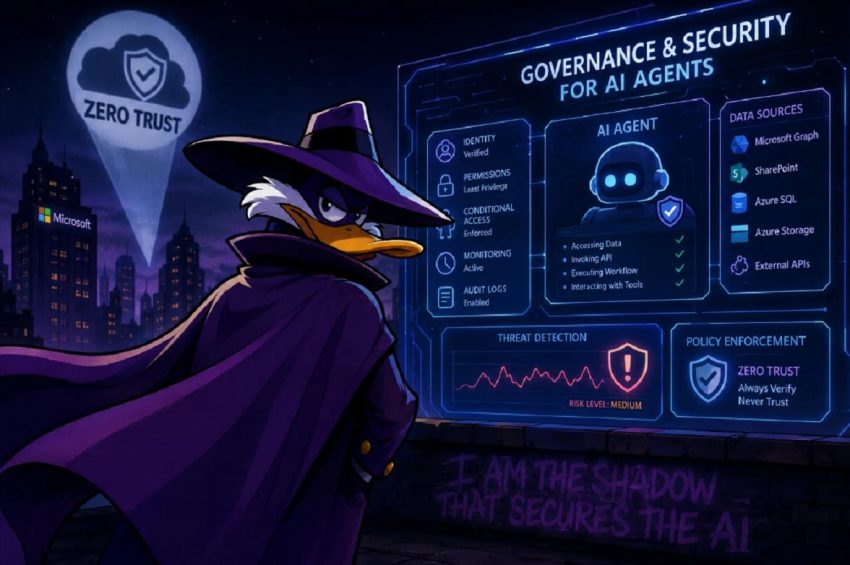
Enterprise AI is rapidly evolving beyond copilots and chatbots. Today’s AI agents can authenticate to enterprise services, invoke APIs, retrieve sensitive business data, execute workflows, and even coordinate with other agents without continuous human interaction.
That fundamentally changes the enterprise security model.
Traditional governance frameworks were designed around users, devices, applications, and infrastructure. AI agents introduce a new identity layer that operates autonomously, often with delegated permissions and access to multiple business systems. As organizations deploy dozens or even hundreds of agents, security teams need to answer a new question:
How do you govern identities that can think, plan, and act?
Microsoft’s latest security guidance focuses on exactly that challenge by extending Zero Trust principles to AI powered workloads through stronger identity governance, observability, and continuous security controls.
AI agents are becoming workload identities
From a security perspective, an AI agent should no longer be viewed as just another application feature.
It behaves much more like a workload identity.
A modern enterprise AI agent may:
- Authenticate using Microsoft Entra Workload Identities or Managed Identities
- Request OAuth 2.0 access tokens
- Query Microsoft Graph
- Access SharePoint, OneDrive, SQL databases, Azure Storage, or Microsoft Fabric
- Execute Azure Functions or Logic Apps
- Trigger Power Automate workflows
- Call internal REST APIs
- Interact with external SaaS platforms
- Collaborate with other AI agents
Each capability expands the organization’s identity perimeter.
Unlike traditional service accounts, AI agents are capable of making contextual decisions based on prompts, retrieved data, and previous interactions. That additional decision layer creates new security considerations beyond conventional identity management.
AI expands the enterprise attack surface
Unlike traditional applications, AI agents introduce entirely new trust boundaries.
A single agent often combines:
- Identity providers
- Large Language Models
- Retrieval systems
- Vector databases
- Business APIs
- External tools
- Sensitive enterprise data
Each component becomes part of the overall attack surface.
An attacker no longer needs to compromise the infrastructure itself. Manipulating prompts, influencing retrieved information, abusing connected tools, or exploiting excessive permissions may be sufficient to alter an agent’s behavior.
From a security architecture perspective, AI security sits at the intersection of:
- Identity Security
- Application Security
- API Security
- Data Security
- Cloud Security
- Supply Chain Security
- Model Security
This is why AI security should not be treated as an isolated discipline. It extends existing enterprise security principles into intelligent workloads.
Discovery is the first step toward governance
Organizations already maintain inventories for users, devices, applications, service principals, and cloud resources.
AI agents should become part of that inventory.
Security teams should be able to answer questions such as:
- Which AI agents currently exist?
- Who owns them?
- Which identity authenticates each agent?
- Which LLM provider is being used?
- Which APIs can the agent invoke?
- Which connectors are enabled?
- Which sensitive datasets are accessible?
- Which business actions can be performed autonomously?
Without centralized discovery, organizations cannot accurately assess their AI attack surface.
Shadow AI has already become a governance concern. Shadow agents represent an even greater challenge because they can execute privileged workflows without being visible to security operations teams.
Observability becomes a security requirement
Infrastructure telemetry alone is no longer enough.
Security teams require visibility into the complete AI execution chain.
Meaningful observability should include:
- Authentication events
- Prompt execution metadata
- Tool invocation chains
- Retrieval operations
- API requests
- Connector usage
- Data access events
- Model responses
- Runtime exceptions
- Token consumption
- Policy enforcement decisions
- Complete audit logs
Correlating this telemetry with Microsoft Defender XDR and Microsoft Sentinel allows investigators to reconstruct AI activity during incident response.
Without observability, determining whether an AI agent exposed confidential information or performed unauthorized actions becomes extremely difficult.
Zero Trust extends naturally to AI
Zero Trust has always been based on one assumption:
Never trust. Always verify.
That principle applies equally to AI agents.
Every request initiated by an agent should be evaluated independently, regardless of where the agent is running.
Organizations should continue applying familiar security controls:
- Least privilege access
- Managed Identities
- Conditional Access where applicable
- Continuous Access Evaluation
- Short-lived credentials
- Just-In-Time privilege elevation
- Risk-based authorization
- Comprehensive auditing
AI agents should receive only the permissions required for their specific business function and nothing more.
New attack techniques require new defenses
AI introduces attack paths that traditional applications simply do not have.
Some of the most important threats include:
- Prompt Injection
- Indirect Prompt Injection
- Retrieval poisoning
- Vector database poisoning
- Sensitive data disclosure
- Excessive agent permissions
- Tool abuse
- Cross-agent privilege escalation
- Model output manipulation
- Unauthorized connector usage
Many of these attacks occur without exploiting operating systems or networks.
Instead, attackers manipulate the reasoning process of the AI itself.
From an infrastructure perspective, every request may appear legitimate while the AI agent performs actions its developers never intended.
Defense-in-depth remains the best strategy
There is no single security product capable of protecting enterprise AI.
Organizations should instead apply layered security controls across the entire AI lifecycle.
A practical architecture includes:
- Microsoft Entra for identity and workload authentication
- Managed Identities instead of long-lived credentials
- Microsoft Purview for data classification and sensitivity labels
- Microsoft Defender for Cloud for workload protection
- Microsoft Defender XDR for threat detection
- Microsoft Sentinel for centralized monitoring and investigation
- Azure Key Vault for secret management
- API gateways enforcing authentication, authorization, and rate limiting
- Content moderation and prompt filtering
- Continuous runtime monitoring and audit logging
Security controls should exist before, during, and after every AI interaction.
Identity governance becomes operational governance
As organizations scale AI adoption, identity lifecycle management becomes increasingly important.
Every AI agent should have:
- A clearly defined owner
- Business justification
- Approved data sources
- Documented permissions
- Lifecycle policies
- Periodic access reviews
- Automated deprovisioning
These governance practices mirror those already used for service principals, enterprise applications, and managed identities.
The difference is that AI agents often make autonomous decisions, making governance even more important than traditional workload management.
The road ahead
Enterprise AI is quickly becoming another operational layer of modern cloud environments.
As agents become more autonomous, they should be governed using the same principles that already secure enterprise identities, applications, and cloud resources.
Organizations that already embrace Zero Trust, identity governance, least privilege, and continuous monitoring have a strong foundation for securing AI workloads.
The next step is extending those controls into AI workflows, ensuring that every identity, every action, every prompt, and every data access remains observable, auditable, and governed throughout the entire agent lifecycle.