
0. Prologue:
“An AI platform isn’t a model. It’s an organism.”
It has:
• blood (data),
• an immune system (Purview + ZTA),
• a nervous system (identity),
• a brain (the LLM),
• organs (tools/plugins),
• muscles (the execution layer),
• skin (the output firewall),
• memory (vector stores),
• an immune response (Defender + analytics),
• a skeleton (governance + policies),
• metabolism (pipelines),
• and metabolic illnesses (drift, poisoning, leaks).
If you want it to live — you must design it like a living system.
1. The Overall Topology: Enterprise-grade AI Platform
Here it is, end-to-end:
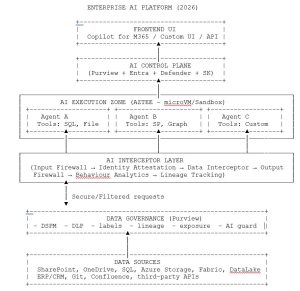
This is the single architecture Microsoft now quietly promotes to strategic clients under the banner of an “AI Security Posture Workshop”.
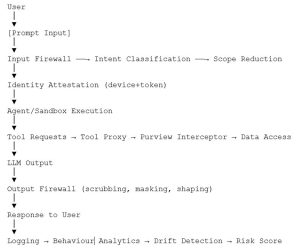
2. AI Data Flow Blueprint (critical diagram)
Full chain: from user request → to answer, from an infra & security standpoint:
3. Trust Boundaries — the new geography of security
The 2026 AI platform has nine trust zones, each critical:
Z0: User Zone
User, device, MFA, CA signals
Z1: Prompt Zone
Everything fed to the model; jailbreak ground zero
Z2: Input Firewall Zone
Lexical & semantic filtering
Z3: Identity Zone
Token, device claims, attestation, session key
Z4: Execution Sandbox Zone
Agent container, runtime isolation
Z5: Tools Zone
SQL/File/HTTP plugins — the most dangerous layer
Z6: Data Interceptor Zone (Purview)
DSPM, DLP, exposure control
Z7: Output Firewall Zone
Redaction, hallucination blocking, sensitive shaping
Z8: Analytics Zone
Drift detection, anomaly detection
Every zone must remain isolated.
4. Token-Flow Architecture (the identity spine)
LLMs operate with tokens, not “permissions”.
Tokens are identity.
Identity is the primary attack surface.
Full 2026 token chain:
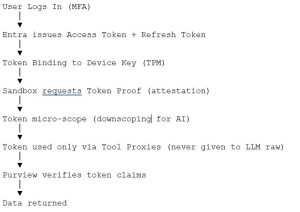
User logs in (MFA)

   │

   ▼

Entra issues Access + Refresh Tokens

   │

   ▼

Token Binding to Device (TPM/Pluton)

   │

   ▼

Sandbox requests Token Proof (attestation)

   │

   ▼

Token downscoping (AI micro-scope)

   │

   ▼

Tools use token via secure Proxies (LLM never sees it raw)

   │

   ▼

Purview validates claims

   │

   ▼

Data returned
Key protections:
• Token Binding
• Session key rotation
• Scope reduction
• Token cloaking (LLM never sees tokens)
• Agent-specific access tokens
• Proxy-only usage
• CA enforced on AI actions
Without this — AI breach = identity breach.
5. Data Governance Blueprint (Purview R&D)
Purview acts as:
• IDS
• Firewall
• DSPM
• DLP
• Classifier
• Risk engine
• Lineage system
• AI guardrail layer
Every AI data request flows like this:
Purview performs:
• sensitive inference detection
• exposure scoring
• exfiltration blocking
• label propagation
• output rewriting
• lineage propagation
• AI drift mapping
It’s the world’s first data-centric Zero Trust for AI.
6. Execution Sandbox Blueprint (AZTEE)
Agent-Level Zero Trust Execution Environment
Sandbox must provide:
6.1. Isolation
• Firecracker microVM
• gVisor
• network egress off
• no shared memory
• no raw filesystem
• no raw sockets
6.2. Controls
• reset context every N steps
• memory wipe
• tool whitelist
• rate limits
• I/O length caps
• scoring hooks
6.3. Internal Logging
Everything must be recorded:
tool calls, proxy decisions, token usage, SQL queries.
7. Toolchain Blueprint
Tools are the “hands” of the LLM.
7.1. MUST HAVE:
• read-only by default
• proxy-based access
• sensitivity filters
• exposure limits
• rate limits
• intent signature
• lineage hooks
7.2. MUST NOT:
• write files
• send emails
• hit external APIs
• access SQL without views
• accept raw user input
• chain tools blindly
8. Output Firewall Blueprint
Your last line of defence.
8.1. Scrubbing Engine
Removes PII, PHI, secrets, URLs, identifiers, project names.
8.2. Structure Normalisation
Checks JSON, CSV, tables, SQL, etc. for exfil patterns.
8.3. Hallucination Filter
Blocks:
• over-precise answers
• reconstructed PII
• suspiciously “realistic samples”
9. Behaviour Analytics Blueprint
Using Defender + Entra + Purview fusion.
Detects:
• non-human-scale access patterns
• enumeration
• semantic exfiltration
• drift
• unusual chaining
• “representative dataset” leak attempts
10. Full Enterprise Blueprint (final architecture)
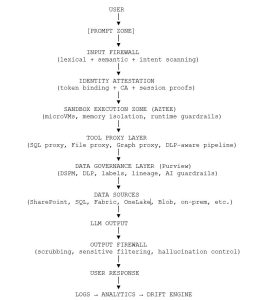
11. CI/CD Blueprint — AI DevSecOpsEvery AI deployment must pass:
• policy tests
• prompt-injection tests
• tool-abuse tests
• DLP simulation
• sensitivity checks
• behaviour regression
• drift analysis
• vector-store integrity
Any failure = rollback.
12. Security Posture Blueprint — Key Metrics
Data Exposure
• sensitive access frequency
• cross-domain queries
• multi-hop queries
Identity
• token replay attempts
• MFA bypass
• attestation failures
Behaviour
• anomaly score
• drift score
• hallucination delta
• PII-in-output frequency
Supply Chain
• plugin signature mismatch
• vector store integrity errors
13. Governance Blueprint
Policies must be:
• IaC
• version-controlled
• auditable
• testable
• immutable
All Purview, Entra, Copilot, Tooling and Sandbox policies must live in Git.
14. Conclusion
This is your 2026 AI architecture.
In short:
AI without security = catastrophe.
AI with security = business accelerator.
And only an architecture built on:
• Purview
• Entra
• Defender
• Sandboxing
• Toolchain isolation
• Output Firewall
• Analytics
• Drift Detection
• Token Binding
makes corporate AI suitable for use-cases — rather than for obituaries.
at the end
Full Series Summary – “AI Security Architecture 2026”
This 8-chapter series maps the real architecture of enterprise-grade AI in 2026 — not the glossy Copilot demo version, but the brutal, engineering-level reality sitting underneath.
Modern AI platforms aren’t “models”. They are multi-layered organisms with identity, memory, tools, metabolism, and failure modes. And every layer — from tokens to toolchains, from semantic stores to output filtering — is a security boundary waiting to be breached.
Across the series, we break down the full stack:
CH1 — The AI Threat Landscape 2026
Why AI attacks scale faster than anything seen in classical cybersecurity. Token theft, semantic inference, prompt-based RCE, LLM-driven lateral movement — and why legacy defences fail.
CH2 — AI Identity & Token Security
Identity is no longer “user-only”. Models inherit user tokens, device claims, session keys. We cover TPM-bound token protection, device attestation, session proofs, and how to stop AI-powered identity replay.
CH3 — Input Firewalls & Prompt Security
Text is now an attack vector.
We detail lexical, semantic, and intent-based filtering, token rewriting, anti-jailbreak algorithms, content scope reduction and role-aware request gating.
CH4 — AI Sandboxing & Runtime Isolation
LLM execution cannot run “in production”.
We describe microVM isolation (Firecracker, gVisor, Kata), context-reset strategies, memory guardrails, rate limiting and runtime kill-switches.
CH5 — Toolchain Security & Proxy Architecture
Tools make AI powerful — and dangerous.
We show how SQL/File/HTTP tools must run through proxy layers with DLP, schema rewriting, intent contracts, rate limits, lineage hooks and strict read-only views.
CH6 — AI Zero Trust Architecture (ZTA 2026)
The core blueprint:
AI Identity → Input Firewall → Execution Sandbox → Purview Data Interceptor → Output Firewall → Behaviour Analytics.
Zero Trust is no longer about users — it’s about models.
CH7 — AI Security Engineering & R&D
The deep dive: poisoning defence, semantic memory attacks, vector store integrity, adversarial testing, supply-chain validation, agent-level isolation and multi-layer output scrubbing.
CH8 — The Final Enterprise Blueprint (2026)
A full architectural map of a protected AI platform:
Control Plane → Interceptor Layer → AZTEE Sandbox → Tool Proxies → Purview Governance → Output Firewalls → Analytics & Drift Engine → CI/CD for AI Policies.
What this series ultimately shows
Enterprise AI must be engineered like a high-risk critical system.
The only safe AI is:
Token-bound
Sandboxed
Proxy-restricted
Governance-controlled
Output-filtered
Monitored
Isolated
Attested
and Drift-aware.
No shortcuts.
No “just deploy Copilot”.
No “LLM inside the production network”.
This series offers the full blueprint — the one real organisations will rely on to avoid a future incident report instead of a success story.
Have a nice holidays my dear friends,
rgds,
Alex