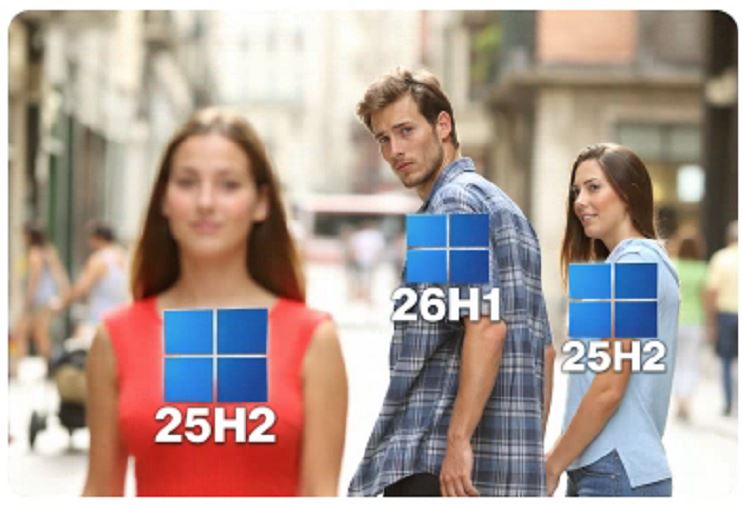
Sooo….. Yesterday Microsoft quietly released Windows 11 version 26H1 and almost immediately had to clarify that this is not the next major feature release. There are no new Start menu redesigns and no dramatic UX changes. What is changing sits much deeper in the stack. Are you ready 🙂 so go ahead!
26H1 is not an evolution of 25H2 in the traditional sense. It is a platform build prepared for a new generation of ARM systems, primarily Snapdragon X2. While 24H2 and 25H2 continued the Germanium based line, 26H1 is built on a newer platform iteration designed around different hardware assumptions. This is not cosmetic engineering. It is architectural.
Architectural shift
Comparing 25H2 and 26H1 at kernel level shows a difference in orientation rather than in feature count.
25H2 represents a stabilised Germanium base with refinements to the scheduler, expanded Copilot plus PC integration and improved support for NPUs in local AI workloads. The system remained broadly hardware agnostic across x86 and ARM.
26H1 moves further towards an ARM first design. This is visible in several areas.
The thread scheduler has been tuned for asymmetric ARM core architectures where performance and efficiency cores behave differently from traditional x86 hybrid models.
Power management integrates more tightly with ACPI and SoC level states, enabling finer grained control over energy transitions.
Memory management is adapted more explicitly for unified memory architectures that are typical in modern ARM systems.
NPU integration is pushed closer to the system layer, meaning AI workloads are routed more directly to hardware acceleration instead of passing through general CPU pathways.
In 25H2 NPU usage was an optimisation layer. In 26H1, on supported hardware, it becomes part of the baseline design.
Release model
Windows 11 24H2 and 25H2 followed the established annual feature update cadence delivered through Windows Update, Windows Update for Business, WSUS and Autopatch. Enterprises could plan, pilot and deploy using enablement packages.
26H1 does not participate in that mainstream lifecycle. It is OEM focused. It is not intended as an upgrade for existing x64 systems. That matters for administrators who see the version number and assume another rollout cycle is approaching.
In practice 26H1 is a starting point for devices that ship with specific silicon. If your estate is built on Intel or AMD, 26H1 is not something you are expected to deploy.
Kernel and driver ecosystem
One of the less discussed differences concerns driver alignment. 25H2 maintains broad WDDM compatibility and a wide hardware support profile across vendors.
26H1 narrows its optimisation scope towards specific SoC platforms. That enables deeper performance tuning but reduces its relevance as a universal enterprise baseline.
From an enterprise planning perspective, 26H1 is closer to a specialised branch than to a mass market release.
Management and deployment impact
From the perspective of Intune, Windows Autopatch and Windows Update rings, 25H2 remains the operational baseline. Compliance policies, update rings and device management strategies remain centred on that version.
26H1 does not redefine management strategy. It introduces no major new compliance constructs or update mechanics. If 24H2 introduced new hardware baselines and 25H2 expanded AI integration in managed scenarios, 26H1 does not alter the enterprise deployment roadmap.
It establishes a separate platform branch for new hardware categories.
Performance and energy behaviour
Where 26H1 becomes technically interesting is on ARM based systems. The refined scheduler and tighter SoC integration allow background AI workloads, telemetry processing and user space tasks to be distributed more efficiently between CPU and NPU resources.
In 25H2 some AI tasks were still CPU orchestrated before being offloaded. In 26H1 routing becomes more direct, reducing latency and improving power efficiency.
For x64 systems this provides no tangible benefit. For new ARM devices it can translate into measurable gains in battery life and sustained performance under AI heavy workloads.
Security posture
From a security capability standpoint, 26H1 does not introduce fundamentally new controls beyond what 25H2 already provided. Virtualisation based security, HVCI, Credential Guard and Smart App Control remain consistent.
The distinction lies in hardware utilisation. New SoC platforms enable stronger use of hardware backed isolation and secure enclaves. The security model itself is not new. The hardware execution context is.
What this really means
26H1 is not the next step for most users or enterprises. It is a platform build aligned with a specific class of ARM hardware. Compared to 25H2 it introduces no visible feature expansion, no new management paradigm and no change in corporate update strategy.
The difference between 25H2 and 26H1 is not in the interface. It is in the foundation.
25H2 remains the universal enterprise release.
26H1 represents a specialised architectural branch designed for new silicon.
For infrastructure planning, the practical roadmap remains 24H2 to 25H2 to 26H2.
26H1 signals something more strategic. Microsoft is no longer treating ARM as an experimental path. It is building a dedicated system base for it.